Textile history · Domestic life
From Coverlet to Duvet: Bed Traditions Behind Coyuchi Duvet Covers
A bed is more than a place to sleep. Its layers tell stories about climate, labor, laundering, trade, and ideas of comfort. The movement from woven coverlets and quilts to removable duvet covers reflects not a simple march toward convenience, but a long conversation between household needs and textile possibility.
At the end of the day, a bed can look like a quiet landscape: a broad plain of linen or cotton, interrupted by folds, stitched borders, and the soft rise of a quilt or comforter. Yet the arrangement is the outcome of centuries of practical decisions. What should lie closest to the body? Which layer should carry the warmth? How often can it be washed, and by whom? The answers have changed with local climate, available fibers, household resources, and the technologies used to spin, weave, sew, and clean cloth.
Coverlets, quilts, blankets, and duvets are sometimes grouped together as decorative bed coverings. Their histories, however, reveal distinct ways of organizing warmth and care. A coverlet is generally a woven bedcover, often designed to be seen. A quilt is made by stitching layers together, usually a top, a filling, and a backing. A duvet is a filled cover intended to be enclosed in a removable outer case. The words and practices vary by region, but the differences help explain how bedding traditions evolved.
Today, Coyuchi duvet covers offer a contemporary point of reference for thinking about that history. The name belongs to the present-day world of bed linens, but the design idea behind a duvet cover—separating a washable outer layer from a warmer inner one—draws on a much older household instinct: protect the costly or bulky layer by putting a more manageable textile between it and everyday life.
The bed as a system of layers
Before modern central heating and routine access to machine washing, warmth was assembled rather than switched on. A bed might be built from a mattress or straw-filled ticking, sheets, blankets, and a top covering. Each layer did a different job. Sheets made direct contact with the sleeper and could be changed or laundered more readily than a heavy woolen blanket. Blankets trapped warmth. A coverlet could add another insulating layer while lending the bed a finished appearance.
That system was never identical everywhere. In cold regions, people might rely on thick wool blankets, feather-filled coverings, or several layers at once. In warmer climates, lighter woven cloth could provide sufficient cover while protecting bedding from dust. Materials depended on what communities could produce, trade, or afford: wool from sheep, linen from flax, cotton through regional cultivation and increasingly wide trade, and down or other stuffing where available.
Textiles also carried meaning beyond their function. The pattern of a coverlet, the quality of its fiber, and the labor invested in its construction could indicate skill, local identity, household standing, or a connection to a particular place. A bedcover might be made for everyday use, saved for special occasions, handed down, or displayed as evidence of careful making. The bedroom was private, but its textiles were often part of a household’s visible material culture.
Coverlets: woven warmth with a visible surface
A coverlet is typically formed on a loom rather than assembled from stitched layers. Weaving brings warp and weft threads together in a structure that can create color, texture, and pattern as the cloth is made. Some coverlets are relatively plain; others feature complex motifs or borders that demonstrate technical knowledge and the character of a region’s weaving traditions.
Because the design is woven into the fabric, a coverlet can be both practical and expressive. The same interlacing that creates its surface also gives the cloth strength and a particular drape. Depending on its fiber and construction, it may add warmth without the bulk of a heavily filled quilt. It can also serve as the visible top layer over sheets and blankets, bringing order and color to a bed.
Coverlet histories are not one universal story. The term has been applied to different kinds of bed coverings in different places and periods, and historic examples can vary greatly in weight, weave, and use. Museums and textile collections often describe objects through their materials, construction, provenance, and regional context because appearance alone cannot tell us whether a textile was made for daily use, ceremonial display, or another purpose.
Those distinctions matter when reading textile history. A patterned bedcover does not automatically reveal who made it, who slept beneath it, or how frequently it was used. Surviving examples are also a selective record: sturdy, carefully stored textiles are more likely to endure than ordinary cloth worn thin through repeated laundering. The objects that remain can illuminate domestic life, but they need to be interpreted with care.
Quilts: warmth held by stitching
Quilting describes the stitching that joins layers of fabric, commonly a decorative or pieced top, an inner filling, and a backing. The stitches prevent the filling from shifting freely and create a patterned relief across the surface. In some traditions, pieces of cloth are assembled into a patchwork top; in others, the design is worked on a single fabric. A quilt may be light or substantial, depending on its materials and construction.
The form is adaptable. Scraps can be turned into useful cloth; a thin filling can add insulation; and the stitched surface can become a record of technique and taste. But a quilt should not be reduced to a story of thrift alone. Quilting traditions have developed in many societies for different reasons, and the motifs, materials, and social meanings attached to them are not interchangeable. Each object belongs to a particular history of making and use.
Quilts also illustrate how domestic labor becomes embedded in objects. Cutting, piecing, layering, and stitching take time. In some contexts, quilts were made by individuals; in others, work could be shared among family or community members. Their practical purpose and their social life often overlapped. A bedcover could provide needed warmth while also marking a household event, preserving memory, or demonstrating a maker’s skill.
Compared with a woven coverlet, a quilt’s layered construction may provide a different kind of insulation and surface. Yet the categories can blur in everyday speech and historical catalogues. A quilt may be described as a bedcover, and regional vocabulary can assign different names to similar objects. For researchers, close attention to stitching, weave, filling, and documented context is more useful than relying on labels alone.
The duvet and its removable cover
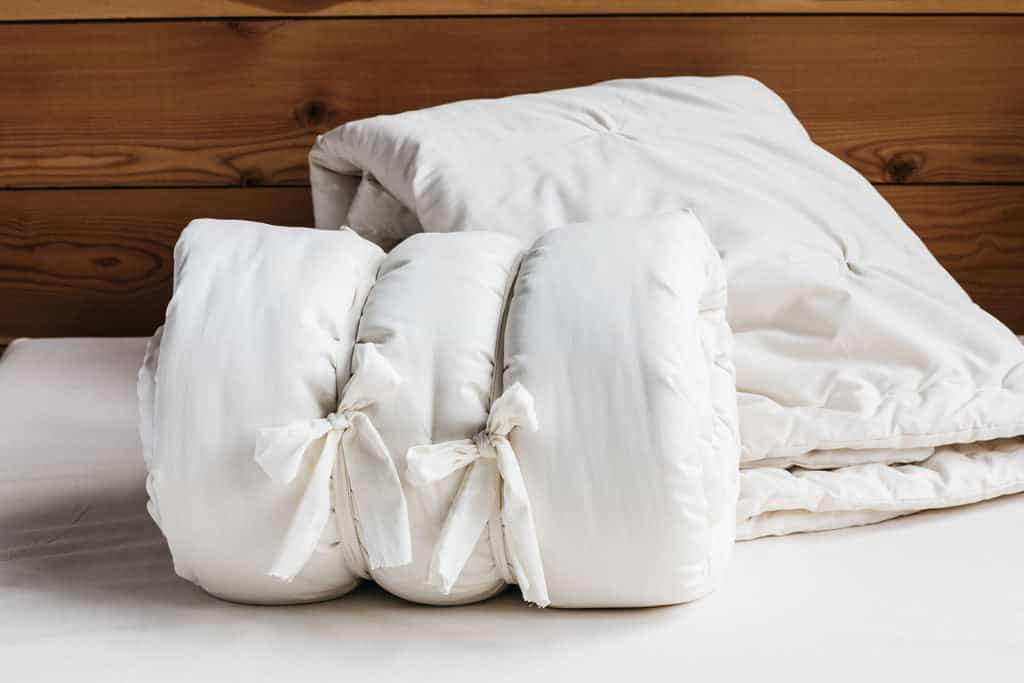
The modern duvet is a filled bed covering, often enclosed in a separate fabric case. Instead of placing several blankets over the sleeper, a household can use one insulated insert inside an outer cover. The cover can be removed for cleaning or changed to alter the bed’s appearance, while the filling remains protected within it. That arrangement makes the outer fabric an active part of bedding care rather than merely a decorative finish.
The term “duvet” is associated with French, where it refers to down. In contemporary use, the word commonly describes a filled insert whether its filling is down, wool, or another material. Names and conventions differ across countries: what one household calls a duvet may be described elsewhere as a comforter or quilt. The objects may overlap in function, but their construction and local use can vary.
The separate cover answers a persistent problem. A bulky filled textile can be difficult to wash and slow to dry. If a removable outer layer receives much of the contact, it can be laundered without subjecting the entire insert to the same routine. This does not mean every duvet insert is easy to clean, or that every cover is suited to every care method. Fiber, stitching, dyes, and manufacturer instructions all matter. The historical principle is simpler: divide the bed’s functions among layers so that each can be handled in a way appropriate to its material.
That division also changes how a bed can be refreshed. A household may keep the same warm insert while changing the cover with the season, the room, or the frequency of washing. A cover can be folded, stored, repaired, or replaced independently. In this sense, the duvet system is both practical and modular: warmth and appearance are linked, but they are not locked into one object.
Care, labor, and the changing household
Changes in bedding cannot be separated from changes in domestic work. Before the spread of household washing machines, laundering heavy textiles demanded water, space, fuel, time, and considerable physical effort. Smaller or lighter washable layers could make upkeep more manageable, though the work itself remained. The introduction of machine washing in many homes altered the frequency and scale of laundering, but it did not make all textiles equally simple to care for.
Removable covers fit into this broader history because they make the bed easier to reorganize. A sheet can be washed frequently; a blanket or insert may need less frequent attention; a cover can be taken off and cleaned according to its fabric’s requirements. The arrangement reflects an increasingly differentiated approach to household textiles, in which each layer is selected not only for warmth but also for how it will be used and maintained.
Care labels are a modern counterpart to older knowledge passed through household practice. They translate the vulnerabilities of a material into instructions: whether a fabric can be washed in water, whether it should be dried flat, and whether heat or agitation may cause damage. Wool, cotton, linen, and down each respond differently to moisture and handling. A removable cover may simplify one part of the routine, but the inner layer still needs attention suited to its construction.
Ease of care is also shaped by access. A household with reliable water, drying space, and laundry equipment can use textiles differently from one without those resources. The apparent simplicity of a modern bed may depend on infrastructure that is easy to overlook. Bedding history is therefore not only a history of design; it is a history of labor, technology, and the conditions under which household routines take place.
From local cloth to a global textile story
Every bedcover is connected to a chain of materials and skills. A wool blanket begins with animal fiber and the work of preparing it for spinning and weaving or filling. A cotton cover begins with a plant fiber that must be harvested, processed, spun, and woven. Linen depends on flax and on a sequence of steps that turn its stalk into usable fiber. The finished cloth may then be cut, sewn, dyed, printed, or quilted.
As trade expanded and textile production changed, households encountered a wider range of fabrics and finishes. Industrial spinning and weaving increased the availability of some textiles, while changing retail systems made coordinated bedding easier to obtain. These shifts did not erase local making. Handwork and factory production have coexisted, sometimes within the same household’s bedding, and the balance between them has varied across place and time.
Modern bedding brands, including Coyuchi, sit within this much longer movement of fibers, processes, and domestic expectations. The connection is not that a contemporary duvet cover reproduces a historic coverlet. It is that both belong to the continuing effort to make a bed comfortable, maintainable, and meaningful. Today’s consumer may consider fiber origin, production standards, texture, and washability in ways shaped by contemporary concerns, while earlier households made decisions around the materials, knowledge, and resources available to them.
For readers interested in textile history, a useful question is not simply whether a newer system is better than an older one. It is: better for whom, under what conditions, and according to which measure? A woven coverlet may have durability and local character; a quilt may combine insulation with visible handwork; a duvet cover may make laundering and seasonal change more flexible. Each form answers a different set of needs.
Reading a bedcover as a historical object
Close looking can reveal a surprising amount. Start with construction. Is the textile woven as one piece, or are separate layers joined by stitching? Examine the edges, seams, and any repeated motifs. Consider the fiber, but avoid assuming that appearance alone can identify it with certainty. Then ask where the object was found, how it entered a collection, and what records accompany it.
Written sources can add context, though they have limits. Household inventories may record a blanket or bedcover without describing its weave. Trade records can trace the movement of fibers or finished cloth, while diaries, letters, and household manuals may offer glimpses of use and care. Such sources reflect the people and institutions that produced them; many ordinary makers and users left few written records. Material evidence and archival evidence work best when read together.
Catalogues and museum collections are valuable starting points, especially when they provide dates, materials, techniques, and provenance. Regional textile studies can help explain how a pattern or construction relates to local practice. When comparing objects, be cautious with broad labels such as “traditional” or “folk.” These terms can flatten differences and make diverse histories seem timeless. Textiles changed as communities moved, traded, adapted techniques, and responded to new materials.
Comfort as a cultural idea
Comfort is not a fixed measure. It includes warmth and softness, but also cleanliness, privacy, appearance, and the feeling of being at home. What one generation regards as a proper bed may seem elaborate to another. In some settings, a carefully dressed bed signaled welcome; in others, practical warmth took precedence over display. The same textile could serve both purposes.
The shift from coverlet to duvet cover is therefore not merely a story of changing shapes. It reflects changing ideas about how a home should look and how household textiles should work. The bed became a place where personal taste, domestic routine, material technology, and expectations of hygiene met. Removable layers made it possible to separate functions that earlier cloth often combined: warmth, protection, decoration, and ease of cleaning.
That separation remains visible in the contemporary bed. Sheets touch the body, an insert provides insulation, and a cover protects the insert while setting the room’s tone. The arrangement may feel ordinary precisely because it is so familiar. But its logic carries traces of older practices: layering against cold, using woven cloth for protection, investing labor in bedcovers, and finding ways to keep valuable textiles in service for longer.
A living history beneath the sheets
To trace bedding traditions is to follow a domestic object across a wide landscape of history. Wool and cotton connect beds to farms, fields, and processing workshops. Weaving and quilting connect them to specialized knowledge and household labor. Washing technologies and changing ideas of cleanliness reshape the way layers are used. Trade and manufacturing influence what fabrics are available, while cultural preferences determine which patterns, colors, and forms feel at home.
Coverlets, quilts, and duvet covers are not successive stages in a single universal sequence. They are overlapping solutions that persist, adapt, and acquire new meanings. A woven coverlet can still be made and used; a quilt can remain both functional and commemorative; a duvet cover can draw on the old practice of layering while making maintenance more modular. Their stories meet on the bed, where practical needs and personal histories are close enough to touch.
Looking at Coyuchi duvet covers through this lens turns a contemporary bedding choice into an invitation to ask larger questions. What is the fabric made from? How is it constructed? Which layer is meant to be washed, and which is meant to last? What forms of work and knowledge lie behind it? The answers do not make sleep more complicated. They make the familiar bed more legible: a small domestic landscape shaped by materials, memory, and the enduring human search for rest.